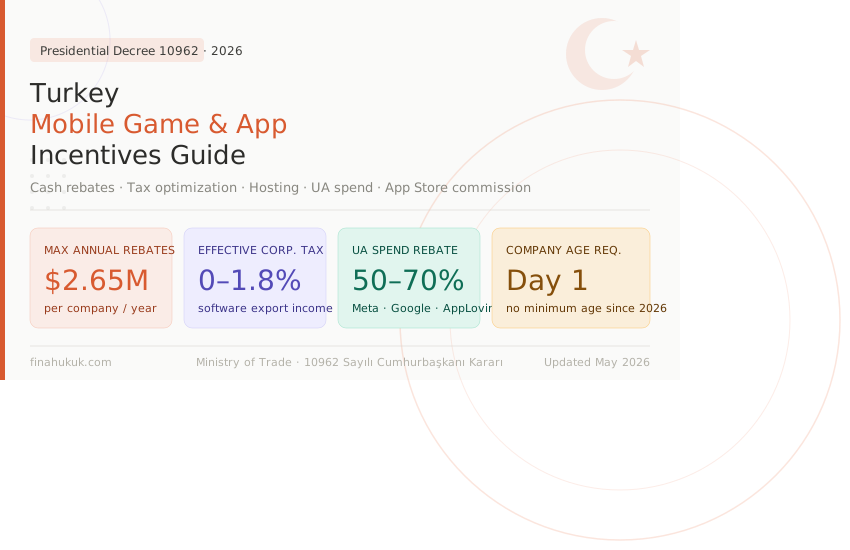
Turkey has quietly become one of the most competitive jurisdictions in the world for mobile game studios, mobile app publishers and SaaS companies that sell internationally. Two factors are driving this: a generous cash rebate program for user acquisition, hosting, commission fees and personnel — and an effective corporate tax rate that, when properly structured, can fall to between 0% and 1.8%.
On 27 February 2026, the Official Gazette published Presidential Decree No. 10962, which repealed the previous Decree No. 5447 and consolidated the country’s fragmented support architecture into a single, simpler framework. The new regime applies retroactively from 1 January 2026. For foreign founders looking at Turkey as a development hub, a publishing entity or a global revenue routing point, the picture has materially improved.
This guide walks through what the new framework actually offers, what changed compared to the prior regime, and how the rebate program interacts with Turkey’s tax regime to create one of the most attractive overall packages available to a mobile game or app publisher today.
Why Turkey for Mobile Game and App Studios
Before jumping into line items, it is worth stepping back. Turkey combines:
- A deep talent pool in mobile game development (the country produced Peak Games, Dream Games, Spyke Games, Gram Games, MasOmo, among others — several acquired in nine- and ten-figure exits to Take-Two, Playtika and Zynga).
- One of the most aggressive government cash-back programs for digital exports in the OECD, now restructured under Decree 10962.
- A corporate tax regime that, for software and digital services exporters, can be reduced to a near-zero effective rate.
- A favorable cost base for engineering talent, server hosting and operational expenses.
- No restriction on foreign ownership of Turkish companies — a foreign founder can own 100% of a Turkish entity and remain the sole shareholder.
The first two points alone make Turkey relevant. The combination is what makes it competitive with Ireland, Cyprus or the UAE for digital export businesses.
The 10962 Decree: What Changed for Mobile Game and Mobile App Companies
Decree 10962 did three structural things: it consolidated previously scattered programs, it removed the one-year company-age requirement that blocked early-stage startups, and it eliminated most pre-approval bureaucracy. For mobile app and mobile game publishers, the headline changes are:
- Marketing rebate is restructured into a single tier (previously three).
- Platform commission rebate caps were raised significantly.
- Hosting/cloud expenses are now an independent category (previously buried inside another program).
- Engineering personnel support was eliminated; in its place, a marketing/BD personnel program was introduced.
- The one-year company-age prerequisite was scrapped — newly incorporated companies can apply from day one.
- Pre-approval requirements were lifted for most line items.
The total annual cap for a single company across all categories now sits at roughly 120 million TRY (~2.65 million USD) in cash rebates, before adding the foreign office and personnel programs.
Eligibility: Prerequisites for Foreign Founders
To qualify for any of the rebate categories, a company must satisfy the following:
- A Turkish A.Ş. (joint stock) or Ltd. Şti. (limited) company. Sole proprietorships are excluded. Foreign ownership is fully permitted; the shareholder can be an offshore holding company, an individual non-resident, or any combination.
- Membership in the Service Exporters’ Association (HİB). This is a one-time registration and a near-formality.
- All expenditures routed through corporate bank accounts with invoices issued to the Turkish entity.
- Apps and games published under a Turkish-domiciled developer account on App Store, Google Play and Steam, with the company’s bank account linked to the store.
- No outstanding tax or social security debt (offsetting against accrued rebates is permitted).
- Marketing activity in foreign languages targeting non-Turkish markets. Campaigns in Turkish or targeting Turkey are excluded.
The previous one-year company-age requirement is gone, which is the single biggest improvement for early-stage mobile game studios looking to launch with a Turkish entity.
Cash Rebate Categories Under Decree 10962
1. Digital Marketing & User Acquisition Rebate for Mobile Game
This is the flagship line item. Spend on Meta, Google, TikTok, AppLovin, Mintegral, Unity Ads, Snapchat, Liftoff, Moloco, ironSource and similar UA channels is reimbursed as follows:
- 50% rebate on qualifying spend (general).
- 70% rebate for spend targeting designated priority countries.
- Per-product cap: 15 million TRY (~330K USD) per year.
- Per-company cap: 50 million TRY (~1.1 million USD) per year.
- Maximum 10 products can be supported simultaneously.
For a publisher with multiple titles, the 10-product ceiling is meaningful — a casual mobile game studio with five live titles can spread the 1.1M USD pool across the portfolio. Pre-approval is not required; applications are made post-spend, within six months.
A practical nuance worth understanding: campaigns can route users either directly to the App Store or to a landing page owned by the company. If the landing page belongs to the applicant, the spend remains eligible. This opens the door to Web2App and Web2App2Web funnels that legitimately bypass App Store commission while still qualifying for the rebate.
2. Platform Commission Rebate (App Store, Google Play, Steam)
Apple, Google and Valve continue to take 15–30% of in-app revenue. Decree 10962 partially offsets this:
- 50% rebate on commission paid to platforms.
- Per-product cap: 4 million TRY (~88K USD) per year.
- Per-company cap: 20 million TRY (~440K USD) per year.
- Up to 10 products supported.
Only commission on non-Turkish revenue qualifies — domestic-market revenue is excluded. The 10-product structure here is more flexible than under the previous decree, where products beyond the third title were heavily disadvantaged.
3. Hosting & Cloud Infrastructure Rebate (New Independent Category)
Previously a sub-line of the broader market-entry program with a low ceiling, hosting is now a standalone category:
- 50% rebate on cloud and hosting spend.
- Annual ceiling: 10 million TRY (~220K USD) of qualifying spend → 5 million TRY (~110K USD) cash back.
- AWS, Google Cloud, Azure, Fal.AI and similar providers are in scope.
- Pre-approval is no longer required.
Important caveat: if the product also has a Turkish version, the rebate base is halved — meaning the effective rate drops to 25%. To capture the full 50%, the product should be exclusively foreign-market-facing. For a global mobile game with no Turkish localization or geo-restricted to exclude Turkey, this is straightforward.
4. Reporting, Attribution and Analytics Tools
The list of supported tools was significantly expanded under the new decree, and pre-approval was removed:
- 50% rebate on subscriptions to qualifying analytics platforms.
- Annual cap: 5 million TRY (~110K USD) of spend → 2.5 million TRY (~55K USD) cash back.
- Eligible tools include: Adjust, Sensor Tower, Mobile Action, Adapty, Apptweak, AppMagic, Mixpanel, RevenueCat, Tenjin, AppMetrica, Airbridge, GameRefinery, SocialPeta, Amplitude, Appnava and others.
The addition of RevenueCat, Mixpanel and Tenjin addresses a long-standing gap. Most subscription-based mobile apps and live-ops mobile game studios were already paying for these tools without rebate eligibility.
5. Software Licenses
The software-license rebate was narrowed under the new decree, which is worth understanding clearly:
- 50% rebate, capped at 5 million TRY (~110K USD) spend / 2.5 million TRY (~55K USD) cash.
- The previous list-based system (Unity, Unreal, Adobe, 3ds Max, Slack, etc.) was replaced by a category-based approach: CRM, Sales Automation, Sales Intelligence, App Analytics, Marketing Automation, Customer Tracking, Conversion Analytics.
- AI tools (ChatGPT, Claude, Cursor, Midjourney, Copilot) are explicitly excluded.
Game engines and creative tools have effectively been moved out of this category. For most mobile game studios, this category is now relevant primarily for sales/marketing software stacks rather than for production tooling.
6. Marketing & Business Development Personnel (New)
The previous engineer-payroll subsidy was eliminated. In its place is a marketing, sales and BD personnel rebate:
- Domestic personnel: 50% of gross salary, capped at 90,000 TRY (~2,000 USD) per person per month.
- Foreign-office personnel: capped at 250,000 TRY (~5,500 USD) per person per month.
- Up to 10 employees total (domestic + foreign combined).
- Eligible titles are limited to: Business Development Specialist, Sales Consultant, Marketing Specialist.
- Bachelor’s degree and a valid foreign-language certificate (issued within the last two years) are required.
- Founders, administrative staff and intra-group transfers are excluded.
- Personnel based in Technoparks, Tekmer or Free Zones are excluded — an important constraint for studios with R&D operations in Turkish technology parks.
7. Foreign Office Rent
For studios establishing a presence abroad (US, UK, Germany, UAE, Singapore are common targets):
- 50% rebate on rent and commission.
- Annual cap: 6 million TRY (~132K USD) per office.
- Up to 10 foreign offices supported.
8. Trade Fair & Event Participation
For events such as Gamescom, GDC, MWC, Pocket Gamer Connects, White Nights:
- 50% rebate on booth, design, sponsorship and travel.
- Cap: 1.5 million TRY (~33K USD) per event (3 million TRY for prestigious events designated by the Ministry).
Tax Incentives: Where Turkey Becomes Truly Compelling
The cash rebate program alone is generous, but the tax side of the equation is where Turkey’s competitiveness becomes structural rather than just attractive.
Corporate Tax: 25% Headline → 9% for Exporters
Standard corporate income tax in Turkey is 25%. For income derived from exports — which now includes a 16-point reduction (raised from the previous 5-point reduction) — the rate falls to 9%. This applies to:
- Revenue from foreign-targeted advertising (in-game ads, ad mediation revenue from non-Turkish users).
- Other digital service and product exports.
The 9% rate is a starting point, not the destination.
Software Export Deduction: 80% → 100%
Under Article 10 of the Corporate Income Tax Law, income from software, design, engineering, data processing and similar services delivered to non-resident customers benefits from a deduction. This deduction was raised from 50% to 80% at the end of 2023, and then — through a Ministry of Finance regulation — to 100%, conditional on repatriating the earnings to Turkey.
Combined with the 9% rate, the effective corporate tax becomes:
- If you do not repatriate earnings: 9% × (1 – 80%) = 1.8% effective corporate tax
- If you do repatriate earnings: 9% × (1 – 100%) = 0% effective corporate tax
For a mobile game or app publisher operating from a Turkish entity, this is materially better than Ireland’s 12.5% headline rate, the UAE’s 9% (with no comparable export deduction), or most Eastern European jurisdictions.
Are Mobile Game and App Sales Treated as Software Exports?
This is the question that determines whether you actually capture the 100% deduction. The Turkish Tax Authority has issued individual rulings (“özelge”) on this question. Of the four rulings we have reviewed, all four concluded that in-app purchase and subscription revenue from mobile games and apps sold via App Store, Google Play and Steam qualifies as software export revenue.
Some negative rulings exist as well — typically, on closer inspection, they were the product of poorly framed application questions that led the authority to a different categorization. Until binding case law is established, the prudent posture for studios seeking certainty is to:
- Geo-restrict the product to exclude Turkey (a common practice that satisfies the “exclusively foreign” requirement found in some rulings).
- Separate revenue streams cleanly: in-app purchases and subscriptions can qualify; in-game ad revenue does not (this is generally accepted as service rather than software export).
- Document the structure before applying, not after.
How the Pieces Fit Together: A Concrete Example
Consider a hypothetical mobile game studio with one live title, generating 5M USD in net annual revenue from international markets:
| Item | Value |
|---|---|
| UA spend (Meta, AppLovin, TikTok) | 1.5M USD |
| App Store / Google Play commission paid | 1.0M USD |
| AWS / cloud spend | 200K USD |
| Attribution & analytics tools | 80K USD |
| Cash rebate (approx., subject to caps) | ~830K USD |
| Pre-tax profit before rebate | 2.0M USD |
| Pre-tax profit after rebate | ~2.83M USD |
| Effective corporate tax (with full repatriation, software export structure) | ~0% |
| Net cash to shareholders | ~2.83M USD |
The same studio operating from a jurisdiction with a 12.5% headline rate, no software export deduction and no comparable rebate program would retain materially less of its revenue.
Strategic Considerations for Foreign Founders
A few practical points before incorporating:
- Choose the entity type carefully. A.Ş. (joint stock) is generally preferable to Ltd. Şti. for tax structuring flexibility, capital raising and transferability of shares.
- Set up the developer accounts under the Turkish entity from day one. Migrating an existing App Store account to a Turkish entity is operationally painful.
- Architect your product for geo-separation. If you want the maximum hosting rebate (50%) and the cleanest software export tax position, geo-restrict Turkey or at least separate the traffic.
- Web2App2Web funnels are the most efficient combination of rebate-eligible UA spend, tax-efficient revenue routing and bypass of App Store commission. We see this becoming the dominant model for subscription apps and live-ops mobile games in 2026.
- The 5-year clock starts per category — the rebate program is available for 5 years per line item, with the clock starting on the first application for that specific category.
- Mind the “performance multiplier” rule. Under the new framework, the rebate amount you can claim in any given year is capped at one-third of the prior year’s exports (a tightening from the previous 5x multiplier). For a studio in fast growth, this can become the binding constraint — and structuring around it requires careful planning of accruals versus payments.
Conclusion
Decree 10962 has streamlined what was already one of the world’s most generous incentive frameworks for mobile app and mobile game exporters. Combined with a 9% corporate tax rate that drops to a 0–1.8% effective rate for software exporters, and a clean treatment of foreign vendor payments, Turkey now offers a package that competes with — and on several dimensions beats — the established offshore jurisdictions.
For foreign founders, the calculus is straightforward. A Turkish A.Ş. with foreign shareholders, properly structured products and clean operational architecture can capture:
- Cash rebates of up to ~2.65M USD per year on operational spend.
- Effective corporate tax between 0% and 1.8% on export income.
- No reverse-charge VAT or withholding tax on foreign-vendor expenses, when structured correctly.
- Access to one of the deepest mobile game and app development talent pools in the EMEA region.
The window to take advantage of this is open now. The new decree is in force, the implementing communiqué has been published, and the Ministry of Trade has begun processing applications under the new framework.
For a tailored assessment of how the 10962 framework and the related tax regime apply to your specific business model, the FinaHukuk team can advise on the rebate program, eligibility structuring and the interaction with the Turkish tax regime.
This article reflects the legal framework as of May 2026 and is intended as general information, not legal or tax advice. Implementation details may evolve as the Ministry of Trade publishes further guidance.