Gaming Incentives in Turkey: The 2026 Guide for Foreign Game Studios
If you run a mobile game or app studio and you are not yet looking at Turkey, you may be leaving real money on the table. The gaming incentives in Turkey are among the most generous government grant programs available to digital exporters anywhere — and as of 2026, they have been rebuilt from the ground up to be faster, broader, and friendlier to newly founded companies.
Here is the part most foreign founders find surprising: foreign ownership does not disqualify you. A studio fully owned by non-Turkish nationals can establish a Turkish company and claim the same cash refunds as a local one. Combine that with a corporate tax regime that takes the rate on in-app and subscription revenue to zero — and to zero on every revenue line for studios based in a Technopark — and Turkey starts to look less like an emerging market and more like a deliberately engineered launchpad for global game publishing.
A word of framing before the numbers, though. These programs are designed to grow Turkey’s gaming ecosystem, not to subsidise paper companies. The government’s clear expectation — sometimes written into the rules, often implicit in how applications are assessed — is that a supported studio is a real, operating business here: hiring local talent, building products, and conducting genuine economic activity. A dormant entity set up purely to harvest refunds is both against the spirit of the program and, in practice, far more likely to run into friction at the accrual and audit stages. Treat the incentives as a reward for building something in Turkey, and the rest of this guide works in your favour.
This guide covers what actually matters in 2026: the cash grants for user acquisition, platform commissions, cloud hosting and tooling — plus the corporate tax and VAT advantages that make the whole structure work. Everything below reflects the current framework introduced by Presidential Decree No. 10962, published on 27 February 2026, which replaced the previous program.
Why Foreign Studios Are Looking at Turkey
Turkey has quietly become one of the most active mobile gaming markets in the world, both as a development base and as a talent pool. The country produced Peak Games and Dream Games — two studios that reached billion-dollar valuations on hyper-casual and puzzle titles — and the ecosystem of engineers, artists, and user-acquisition specialists they trained is now spread across hundreds of smaller studios.
For a foreign founder, the appeal is straightforward. Development costs sit well below Western Europe and North America. The talent understands free-to-play economics, LTV/CPI dynamics, and ad monetization at a deep level. And the state actively pays studios to spend on growth abroad. The gaming incentives in Turkey are not a tax credit you claim years later — they are direct cash refunds against money you were going to spend anyway on Facebook, Google, Unity, AWS, and your analytics stack.
The Core Gaming Incentives in Turkey: Cash Refunds Under Decree 10962
The Ministry of Commerce administers these grants through the Service Exporters’ Association. Each support item has its own annual cap and its own five-year clock that starts independently. The headline figures below are stated in Turkish lira, the statutory currency of the program, with approximate USD equivalents at the May 2026 rate of roughly ₺45.7 per dollar. All caps are indexed to inflation and revised upward each year.
1. Advertising and User Acquisition Support
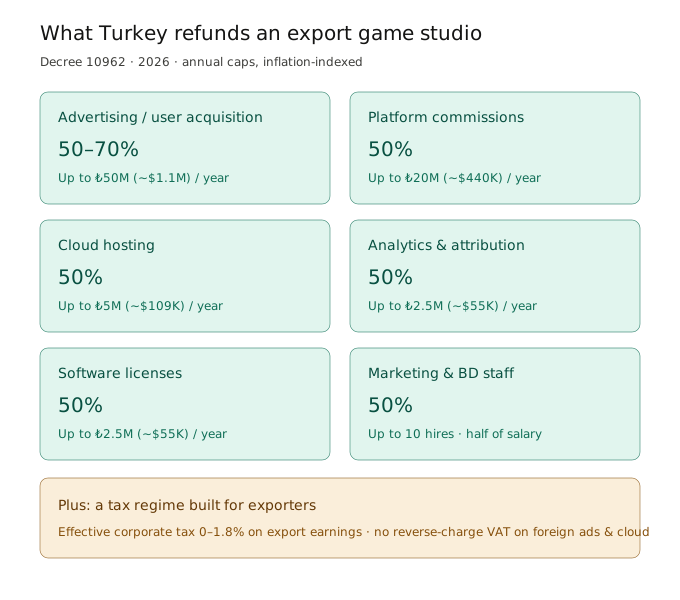
This is the item most studios care about, because UA is where the money goes. The state refunds 50% of your digital advertising spend — rising to 70% in designated target markets — across platforms such as Meta, Google, TikTok, and Unity.
The 2026 structure is refreshingly simple: a company-wide refund ceiling of ₺50 million (~$1.1M) per year, with up to ₺15 million (~$328K) per product, spread across as many as 10 products. The old three-product bottleneck is gone, so portfolio publishers and hyper-casual studios running many titles can finally distribute their budget across the whole catalogue.
Crucially, the one-year company-age requirement has been abolished. A studio incorporated this morning can apply this afternoon.
2. Platform Commission Support
Apple and Google take their 15–30% cut on every transaction. The state gives half of it back. Commission support refunds 50% of the platform commissions deducted on your published games, up to ₺4 million (~$88K) per product and ₺20 million (~$440K) company-wide per year, again across up to 10 products.
One condition matters: commissions on revenue from the Turkish market are excluded. Only your foreign-sourced commissions qualify — which means clean separation of domestic versus international revenue is essential (more on that in the tax section).
3. Database and Reporting Tool Support
Your analytics and attribution stack is now subsidised at 50%, up to a ₺2.5 million (~$55K) refund per year on as much as ₺5 million of spend. The 2026 decree did two valuable things here: it removed the pre-approval requirement, and it dramatically expanded the eligible tool list.
Covered platforms now include Adjust, Sensor Tower, Mobile Action, Adapty, Appnava, SocialPeta, Amplitude, GameRefinery, Apptweak, AppMagic, Mixpanel, RevenueCat, Tenjin, AppMetrica, and Airbridge. The addition of RevenueCat, Tenjin, and Mixpanel — tools the industry actually lives in today — closes a long-standing gap.
One billing nuance to plan for: if you pay annually in a single lump sum, the accrual is treated as beginning twelve months later, so monthly or quarterly invoicing can accelerate your refund timing.
4. Cloud Hosting Support — The Standout New Item
For any studio running live-service titles or global subscription apps, this is the headline change of 2026. Cloud hosting is now a standalone support item rather than a buried sub-line, with 50% of AWS, Azure, Google Cloud and similar spend refunded, up to ₺5 million (~$109K) per year on as much as ₺10 million of hosting cost. Pre-approval is no longer required, and the support runs for five years.
There is one important carve-out. If your product also ships a Turkish-language version, the refund is calculated on only 50% of the spend — effectively a 25% rate. To capture the full 50%, the product must be genuinely export-only, and the invoicing should be separable by product. For studios building purely for global markets, this is one of the most valuable lines in the entire program.
5. Software License Support
Software licensing is refunded at 50%, up to ₺2.5 million (~$55K) per year. The 2026 framework moved from a fixed list to a category-based system covering CRM, sales automation, sales intelligence, app analytics, marketing automation, customer tracking, and conversion analytics tools.
A word of caution: AI tools are explicitly excluded from this category. If your stack leans heavily on AI tooling, do not buy licenses solely to claim this grant — the Ministry’s implementation details are still settling, and it is worth waiting for clarity before committing spend on this item alone.
6. Marketing and Business Development Personnel Support
The previous engineer-salary grant was discontinued. In its place, the state now subsidises 50% of salaries for marketing, sales, and business development hires — the people who drive your growth and revenue, not your codebase.
Eligible roles carry the titles Business Development Specialist, Sales Consultant, or Marketing Specialist. Domestic hires are supported up to ₺90,000 (~$1,970) gross per month per person; staff at an organically affiliated office abroad up to ₺250,000 (~$5,470) per month. You can support up to 10 people in total.
The conditions are specific: a bachelor’s degree, a language certificate obtained within the last two years (YDS C-level, TOEFL 84, or equivalent), and an application filed no later than six months after the hire. Company shareholders, administrative staff, and intra-group transfers do not qualify. One critical restriction for foreign founders to note: personnel based in a Technopark, Tekmer, or Free Zone are excluded — a meaningful constraint, since a large share of Turkish studios sit inside Technoparks.
The Tax Side: Why the Structure Actually Pays Off
Grants put cash back in your account. The tax regime decides how much of your profit you keep. Two changes make Turkey unusually attractive for an export-focused game studio.
The Tax Side: Why the Structure Actually Pays Off
Grants put cash back in your account. The tax regime decides how much of your profit you keep — and for a game studio, the answer depends entirely on the type of revenue. The standard corporate tax rate in Turkey is 25%, but an export-focused studio can bring the rate on its core revenue all the way down to zero. The key is to separate your income streams cleanly, because each is treated under a different regime.
Corporate Tax by Revenue Type
In-app purchases and subscriptions — 0%. Revenue from in-app sales and subscriptions sold to users abroad qualifies as software and license export. Earnings from software and related services delivered to foreign clients now carry a 100% exemption, provided the full earnings are repatriated to Turkey. The practical result is a 0% effective corporate tax on this revenue — for most game and subscription-app studios, the single largest line on the income statement.
Advertising revenue — 12.5% (from 2027). Ad revenue is not treated as software export, so it does not qualify for the 100% exemption. It remains taxable, but the export-rate reduction brings it down to 12.5%, effective from 2027. This is exactly why clean separation matters: your in-app and subscription revenue is exempt, while your ad revenue is taxed under a separate rule. Reporting them together can cost you the exemption on the income that deserves it.
Inside a Technopark — 0% on everything. If your studio operates from a Turkish Technopark (Teknopark), all of its income — including advertising revenue — is exempt from corporate tax. For a studio with a heavily ad-monetized portfolio, locating in a Technopark converts that 12.5% ad-revenue rate to 0%. The trade-off to weigh: as noted in the personnel section above, staff based inside a Technopark fall outside the marketing-personnel grant, so the optimal structure depends on your revenue mix and headcount plans.
The policy intent is explicit: the state wants founders to bring their foreign earnings home, and it has priced that behavior at zero tax on core game revenue. For a foreign-owned studio, the practical requirement is an accounting setup that can clearly evidence both the revenue split and the repatriation.
Eligibility: Who Can Claim, and How
The requirements are deliberately accessible, and foreign founders meet them as easily as locals:
- Incorporate in Turkey as a joint-stock (A.Ş.) or limited (Ltd.) company. Foreign ownership is fully permitted and welcome.
- Spend from the company’s Turkish bank account. Payments routed through individuals or other entities, or made by non-bank methods, are not supported.
- Publish the game under the company’s own App Store or Google Play account. Spend on apps belonging to a different person or company does not qualify.
- Direct the spend abroad. Expenditures aimed at Turkey or made in Turkish are out of scope.
- Carry no outstanding tax or social-security debt during the accrual period (offsetting is possible).
- Become a member of the Service Exporters’ Association, then submit the required information and documents.
The Bottom Line
A well-structured, export-focused game studio in Turkey can refund 50–70% of its user-acquisition spend, half of its platform commissions, half of its cloud and tooling costs, and half of its growth-team salaries — while paying 0% corporate tax on its in-app and subscription revenue (and on all revenue if based in a Technopark), and avoiding reverse-charge VAT on its foreign ad and infrastructure spend.
The same studio, set up carelessly, can miss every one of these benefits and overpay for years. The difference is rarely knowledge of the rules — it is the discipline of structuring the company, the bank flows, the product geo-fencing, and the documentation correctly from the start.
Finahukuk manages this entire incentive process on behalf of game and app studios — from Service Exporters’ Association membership through application, documentation, and refund collection — on a success-based model. If you are weighing Turkey as a base for your studio, or you already operate here and suspect you are claiming less than you could, we are happy to map out exactly which gaming incentives in Turkey your titles qualify for.
